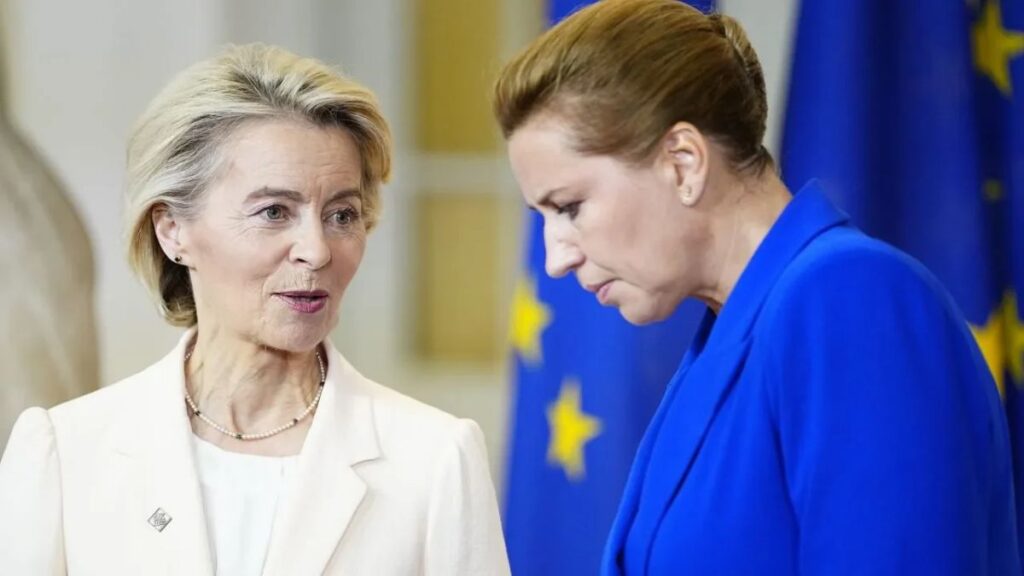
The Danish government is preparing new measures to tighten its migration policy and speed up the deportation of foreigners who have no legal right to remain in the country. Among the plans announced by Prime Minister Mette Frederiksen is the creation of a return center located outside the European Union.
Speaking at the opening of the new parliamentary session, the Social Democratic prime minister stressed the importance of preserving Denmark’s identity and social cohesion. Frederiksen urged Danes to “hold on to who we are” and defended the country’s continuity as “a people and a nation.”
Her remarks reflect the migration strategy pursued by successive Danish governments in recent years, with Frederiksen making the issue one of the main priorities of her administration. Copenhagen argues that the state must retain the ability to determine who can enter the country, who can remain and who must leave.
A return center outside the European Union
One of the government’s proposals is to have a return center operating outside EU territory by the end of 2027. The facility would be intended for foreigners who have received deportation orders and have no legal right to remain in Denmark while the authorities complete the removal process.
The proposal comes amid a broader European debate over how to manage irregular migration and improve deportation procedures. Denmark has argued for years that European countries need more effective mechanisms for carrying out removal orders and preventing people without a legal right to stay from remaining in Europe indefinitely.
Copenhagen has therefore supported arrangements that would allow some migration and return procedures to be handled outside the EU’s borders. The idea has also attracted growing attention from other European governments as pressure increases to improve deportation and return rates.
Tougher controls on deportations
The Danish government also plans to expand facilities for foreigners awaiting deportation. One of the measures under consideration is the construction of a prison at the Kærshovedgård return center.
The facility houses foreigners who do not have a legal right to reside in Denmark but whose removal has not yet been possible. The proposed prison would increase the authorities’ capacity to monitor people awaiting deportation and reduce the risk of them disappearing before their removal can be carried out.
The plans add to a broader tightening of Denmark’s migration policy over the past several years. The country has introduced stricter requirements in areas including asylum, family reunification and permanent residency, while also promoting programs designed to encourage foreigners to return voluntarily to their countries of origin.
A migration strategy driven by the Social Democrats
The Danish approach is particularly notable because these policies are being promoted by a Social Democratic government rather than by a nationalist right-wing party.
Frederiksen argues that protecting Denmark’s welfare state and maintaining social cohesion require tighter control over the country’s borders and migration flows. This position has allowed the Danish Social Democrats to distinguish themselves from much of the European left on immigration policy.
The prime minister has also argued that European left-wing parties underestimated for years the social and economic consequences associated with high levels of immigration. Her approach combines support for Denmark’s welfare model with restrictive migration policies and a greater emphasis on integration and the return of people who have no legal right to remain.
Denmark has consequently become one of the most prominent examples in Europe’s migration debate: a Social Democratic government seeking tighter border controls, stricter conditions for residency and greater capacity to enforce deportation orders.