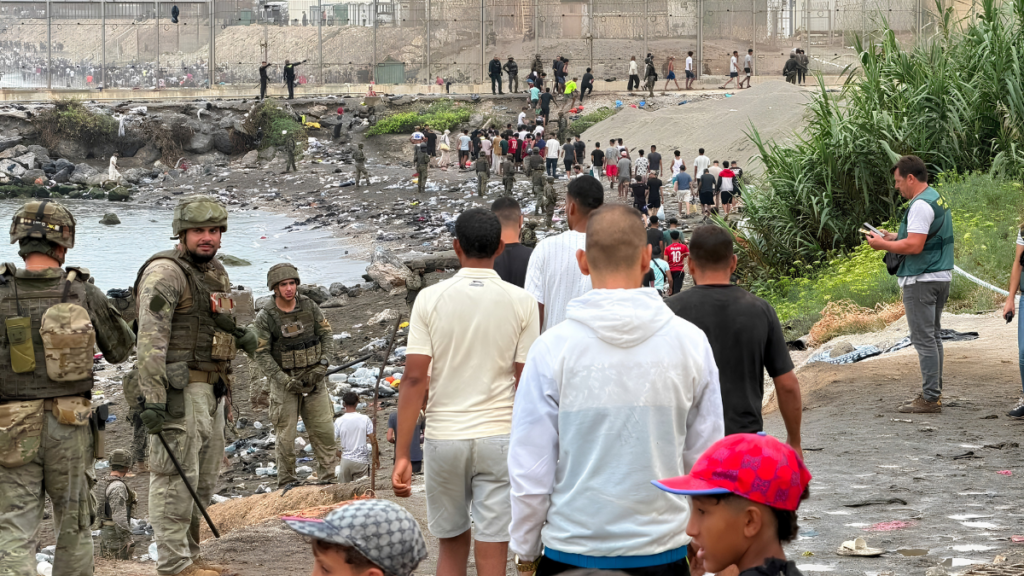
European Union interior ministers have initiated emergency consultations following an unprecedented influx of migrants crossing from Morocco into the Spanish autonomous city of Ceuta over recent days.
The arrival has strained local reception capacity and prompted calls from several EU member states to implement temporary checks along internal European borders to manage potential secondary movements.
While thousands of individuals have already been returned to Morocco under existing bilateral protocols, local authorities in Ceuta continue to request national emergency support to process remaining arrivals and stabilize public services.
Key Proposals on the Ministerial Agenda
-
Internal Border Surveillance: Targeted reintroduction of document verification along primary transit corridors within the bloc.
-
Pre-Frontier Monitoring: Strengthening joint intelligence operations to identify online human-smuggling networks operating across North Africa.
-
Frontex Operational Support: Accelerating rapid-intervention deployments and logistical assistance at the EU’s southern perimeter.
-
Third-Country Engagement: Expanding bilateral return agreements and border-management partnerships with regional governments.
Debate Over Schengen Integrity
The situation has triggered sharp political disagreement across European capitals. Officials in several Northern and Central European states have urged strict measures to protect Schengen’s outer boundaries, with Rome temporarily tightening border surveillance on select transport routes.
Spanish officials maintain that the situation in Ceuta remains localized under the enclave’s specific border regime, emphasizing that no illegal entries into continental Europe have occurred. European Commissioner for Home Affairs Magnus Brunner noted that while external security remains a priority, any internal travel restrictions must remain strictly temporary, proportional, and within legal parameters.