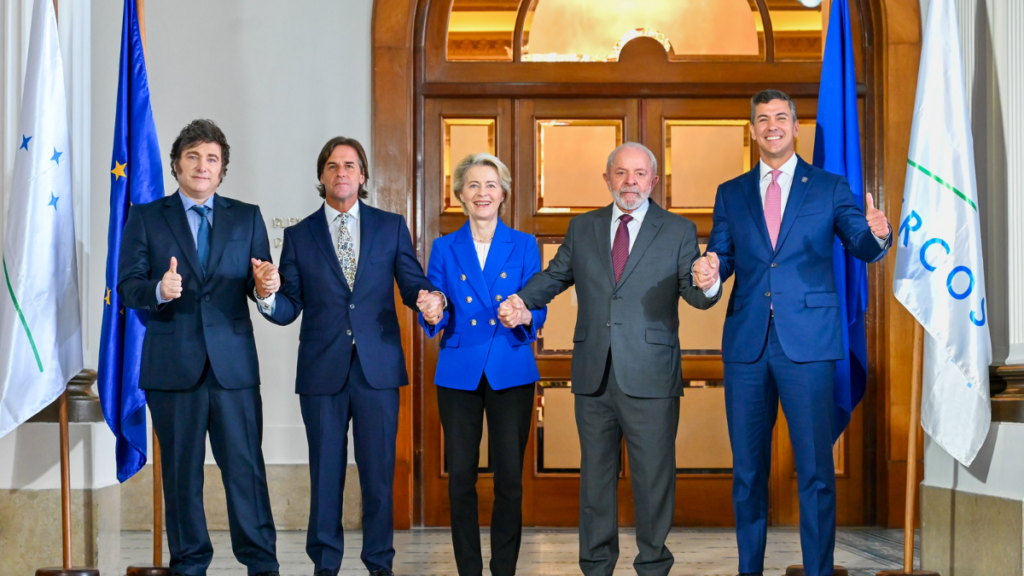
Spain’s two largest political parties have supported the accelerated approval of safeguard mechanisms linked to the EU–Mercosur trade agreement, a move that has drawn sharp criticism from Vox and agricultural groups.
The measures, described by EU institutions as protective clauses aimed at shielding European producers, were endorsed despite concerns that they may prove insufficient to counterbalance competitive pressure from South American imports.
Vox has argued that the safeguards lack binding force and were not incorporated into the original agreement signed by Mercosur countries — Argentina, Brazil, Paraguay and Uruguay. According to the party, the clauses are unilateral instruments developed at EU level and do not form part of the core trade treaty.
Representatives from Vox’s delegation in the European Parliament contend that the mechanism is not automatic and would require further political decisions before being activated. They also argue that it could only be triggered after demonstrable economic harm has already occurred, and even then on a temporary basis.
Political and Legal Tensions Over Implementation
Jorge Buxadé, head of the party’s delegation in Brussels, criticised what he described as a broader pattern in EU trade policy, linking the agreement to years of cross-party consensus among mainstream European forces. In his view, the safeguards do not fundamentally alter the potential impact on livestock and crop producers.
MEP Mireia Borrás echoed those concerns, questioning whether the measures would offer effective protection in practice. She cited previous trade agreements, including the EU’s arrangement with Morocco, arguing that defensive mechanisms in past cases were slow to materialise.
Critics have also warned of possible circumvention routes, suggesting exporters could reroute goods through other Mercosur countries or adjust export formats in ways that limit the safeguards’ impact.
Vox maintains that the issue goes beyond technical adjustments and instead calls for a reassessment of the trade agreement itself. The party reiterates that it opposed the deal from the outset and supports ongoing legal challenges aimed at delaying its implementation.
Supporters of the EU–Mercosur agreement, however, argue that the deal represents a strategic opportunity for European exporters, expanding market access and strengthening trade ties with South America.
The debate continues to highlight deep divisions over trade liberalisation and agricultural protection, both in Spain and across the European Union.