The chief executive of Ryanair, Europe’s largest airline by passenger volume, has raised a stark warning about the financial resilience of several smaller continental airlines, arguing that sustained high oil prices could trigger a wave of insolvencies before the year is out.
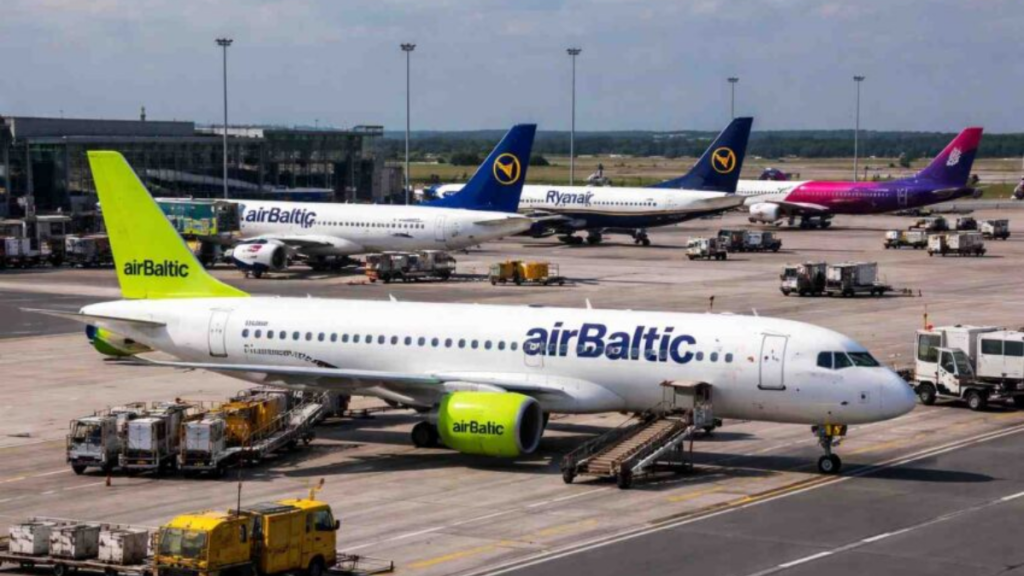
Michael O’Leary, speaking to Italian financial daily Il Sole 24 Ore, stated that between two and three European airlines risk collapse in October or November if fuel prices remain at current levels. He named budget airline Wizz Air and Latvian flag airline airBaltic as among those he considers most at risk — adding that any such failures would benefit Ryanair by reducing competitive pressure.
“If oil stays at these levels, two or three European airlines in October or November could go bankrupt.”
O’Leary attributed the cost pressure directly to the ongoing conflict involving Iran, which he said had already added $50 million to Ryanair’s fuel bill in April alone. The comments underscore how geopolitical instability in the Middle East is beginning to translate into tangible operational strain for the aviation sector.
Latvian parliament acts to stabilise airBaltic
The warning arrives at a politically sensitive moment for airBaltic. Earlier this month, Latvia’s parliament, the Saeima, approved an emergency €30 million short-term loan to the airline, explicitly citing the need to mitigate damage caused by the Middle East conflict on the airline’s finances. The loan is due to be repaid by 31 August this year.
airBaltic is majority owned by the Latvian government, with the Lufthansa Group holding a 10 per cent minority stake. Based primarily in Riga, the airline also operates hubs in Tallinn, Vilnius and Tampere, serving destinations across Europe and, to a lesser extent, North Africa and the Middle East.
A request for comment sent by this publication to airBaltic had not received a response at time of publication.
Wizz Air rejects the characterisation
Wizz Air moved swiftly to contest O’Leary’s claims, issuing a statement dismissing them as “flatly untrue and false”.
The Budapest-based low-cost airline, which operates more than 200 routes globally from bases including London Luton and Bucharest, pointed to what it described as a strong balance sheet, substantial liquidity reserves, and the competitive advantage of a fleet that is already 75 per cent composed of next-generation A320neo family aircraft — a configuration it argued gives the airline a structural fuel-cost advantage over rivals.
The airline also highlighted its hedging strategy and long-standing relationships with aircraft lessors as further buffers against the current price volatility.
Wizz Air chief executive József Váradi appeared to treat the remarks with some scepticism. In an interview earlier this year, he noted that O’Leary has issued similar predictions so frequently that, in his estimation, Wizz Air had “gone bankrupt at least ten times with him”.
The Hungarian airline has faced repeated predictions of its demise from O’Leary dating back at least to 2019, when the Ryanair boss predicted a wave of European airline consolidation.
A pattern of provocation
O’Leary’s comments are consistent with a long-standing rhetorical approach: making pointed, often market-moving statements about competitors that blend genuine competitive analysis with what critics regard as deliberate destabilisation.
While the underlying fuel cost pressures he describes are real and verifiable, the precision of his insolvency predictions has historically been questioned by those he has targeted.
What is not in dispute is that the current operating environment is unusually difficult for airlines without the scale or hedging capacity of a Ryanair.
Whether his specific predictions prove accurate will depend substantially on how long the current period of elevated fuel prices persists — and on whether the geopolitical situation that is driving them shows any sign of resolution.
Related news