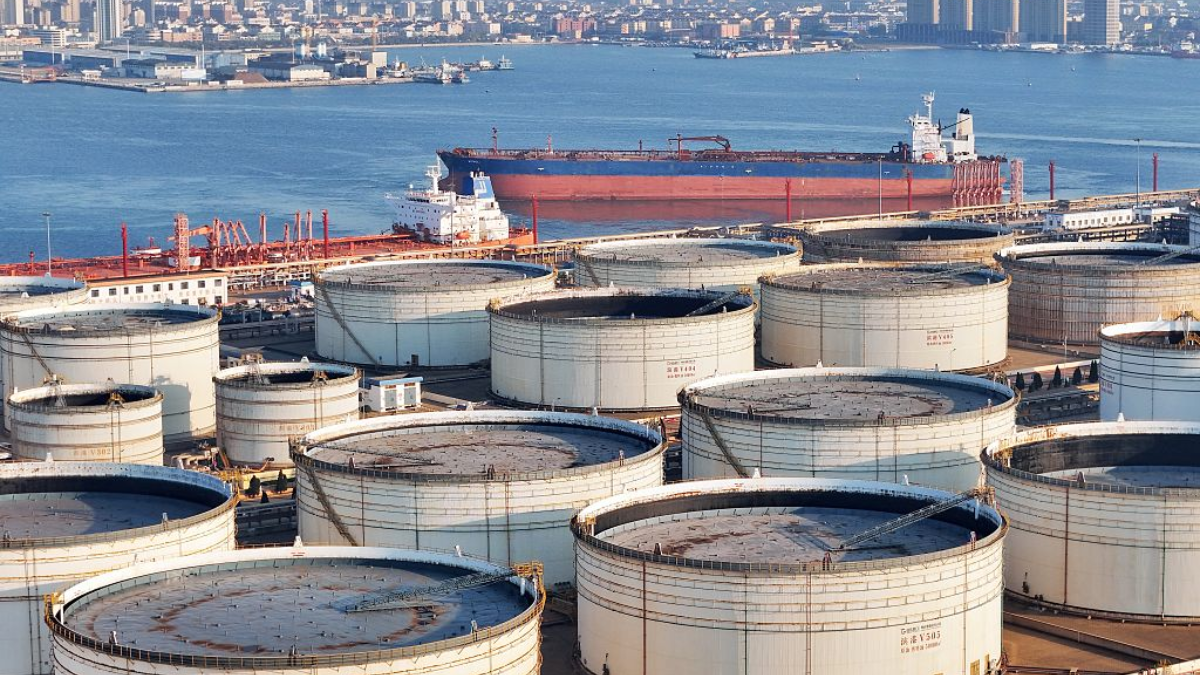
 Oil storage facilities in Longkou Port Area, Yantai City, Shandong Province, China on November 14, 2025
Thank China for saving global economy, ECB analysts say
China’s vast strategic oil reserves and aggressive transition toward electric vehicles and renewable energy have played a pivotal role in shielding the global economy from a catastrophic energy crisis, according to a recent analysis by European Central Bank (ECB) economists.
In a detailed assessment published this week, ECB analysts revealed that Beijing’s proactive stockpiling and shifting energy mix have successfully cushioned the international market from severe supply shocks triggered by ongoing military escalation in the Middle East.
Strategic Stockpiling and Fleet Electrification
According to the ECB report, China’s decision to build up substantial crude oil inventories—expanding its reserves from 92 days of import coverage in 2023 to 115 days earlier this year—provided an indispensable buffer for global markets.
Combined with rapid structural shifts toward electric vehicle (EV) adoption and a temporary drop in domestic petrochemical consumption, Beijing significantly curtailed its demand for foreign crude imports precisely as supply lines tightened.
“Beijing’s substantial stockpiling of crude, accelerated shift to electric vehicles, and reduced domestic petrochemical consumption have contributed to a comparatively muted rise in global oil and gas prices.”
A Disproportionate Supply Shock Contained
The stabilization achieved by reduced Chinese demand is particularly striking given the sheer scale of the disruption. The conflict involving Iran removed roughly 14 million barrels per day (bpd)—representing nearly 14% of total global oil production—from international markets following disruptions in the Strait of Hormuz.
By contrast, the energy shock following Russia’s invasion of Ukraine in 2022 removed approximately 1 million barrels per day, or just 1% of world supply. Yet, despite a disruption fourteen times larger in volume, peak price increases remained nearly identical: crude prices rose 29% in the current crisis, compared to a 30% spike in 2022.
Broader Market Factors & Escalation Risks
In addition to China’s demand buffer, the ECB highlighted that strong U.S. shale production, coordinated releases from Western strategic petroleum reserves, and initial trader expectations of a swift diplomatic solution helped suppress panic buying. Brent crude hovered around $90 per barrel on Monday after briefly touching $100 last week.
However, central bank analysts warned against complacency. With vital maritime choke points remaining volatile, any prolonged closure of shipping lanes could rapidly exhaust existing global reserves and reignite severe inflationary pressure across major Western economies.