Austria’s ruling tripartite coalition is facing mounting political headwinds as the latest polling data signals a steady erosion of support for its three member parties.
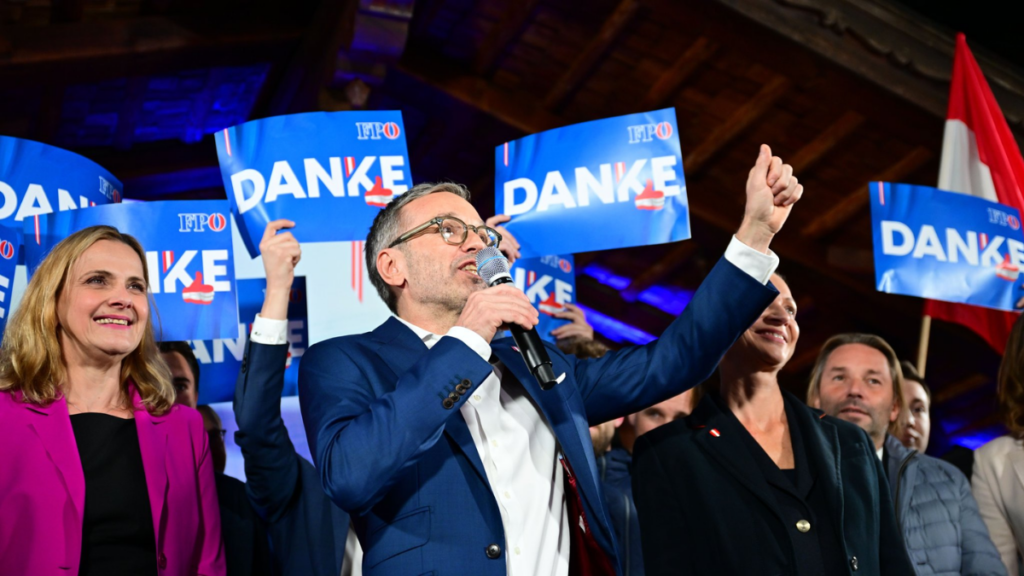
According to a survey conducted by the Market Institute for the daily newspaper Der Standard, the sovereigntist Freedom Party of Austria (FPÖ), led by Herbert Kickl, has consolidated its position as the country’s leading political force with 36% of voting intention — a result that underscores the deepening difficulties confronting the current government.
The coalition, formed by the conservative Austrian People’s Party (ÖVP), the centre-left Social Democratic Party of Austria (SPÖ), and the liberal NEOS, is navigating a period of pronounced strain. The ÖVP stands at 20% and the SPÖ at 19%, while NEOS holds 9%.
Taken together, the combined support for the two largest governing parties barely exceeds that of the FPÖ alone — a scenario widely regarded as unprecedented in recent Austrian political history.
The poll comes at a particularly challenging moment for the federal executive, which is under significant pressure to implement fiscal consolidation measures amid deteriorating economic forecasts. Internal disagreements over the coalition’s policy direction have added further strain to an already fragile governing arrangement.
The FPÖ has led Market Institute surveys uninterrupted since late 2022. The ÖVP briefly narrowed the gap during the 2024 parliamentary election campaign, but following the vote, the FPÖ expanded its lead once again as support for both the conservatives and the social democrats continued to decline.
Notably, the Greens have also seen their standing improve since the last general election. Like the FPÖ, the party has gained three percentage points compared to the 2024 National Council elections, suggesting that the opposition as a whole is benefiting from the government’s difficulties.
In assessments of potential chancellorship candidates, Kickl again tops the rankings. The Market survey places him at 29% support in a hypothetical direct election for chancellor. Incumbent Chancellor Christian Stocker of the ÖVP follows at 17%, up three points from the previous poll.
While the next scheduled general election is not due until autumn 2029, several regional contests are set to take place before then — offering the parties opportunities to test their standing with voters in the intervening period.