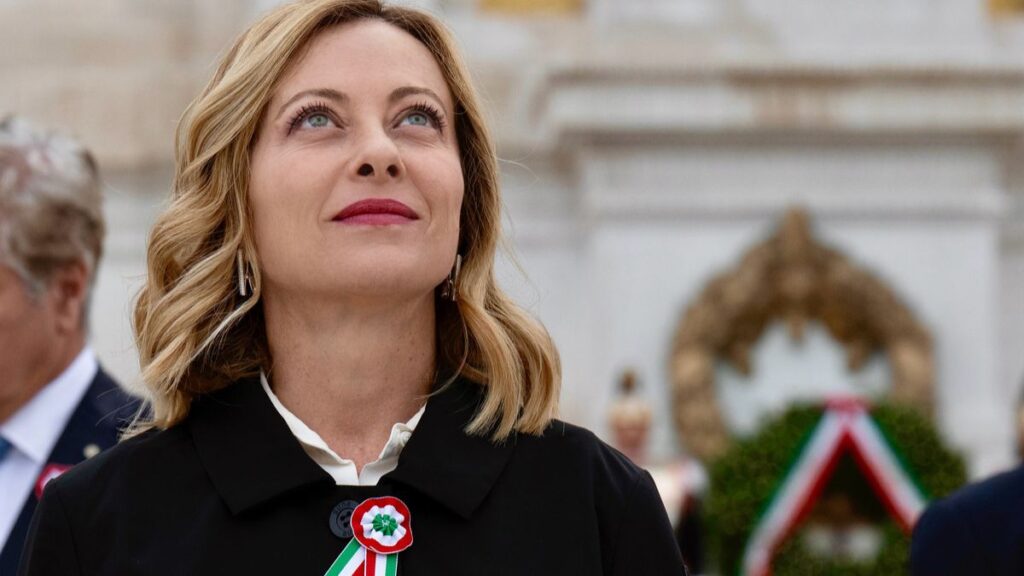
The Italian government, led by Prime Minister Giorgia Meloni, has taken a new step to protect national identity and strengthen public security. Her party, Brothers of Italy (FdI), presented a bill this Wednesday in the Chamber of Deputies that bans the use of the Islamic full veil—such as the burqa or niqab—in public spaces, schools, universities, and offices. The initiative also aims to monitor the funding of mosques and to toughen penalties for forced marriages.
FdI deputy Sara Kelany, one of the proponents of the proposal alongside spokesperson Galeazzo Bignami and Deputy Minister of Justice Andrea Delmastro, explained that the measure “will serve to counter the creation of enclaves and parallel societies where Sharia law is applied instead of the Italian legal system, and where Islamic fundamentalism thrives.”
The legislative text, composed of five articles, establishes in its fifth point that “the use of garments that cover the face, masks, or any other means that prevent personal identification in public places, educational institutions of any level, universities, offices, or commercial establishments is prohibited.” Violations will be punished with fines ranging from 300 to 3,000 euros.
Additionally, the bill regulates the funding and construction of places of worship, aiming to ensure transparency regarding the source of funds and to prevent them from coming from organizations or states with purposes contrary to the Italian legal system. Donations from abroad must be expressly reported to the Ministry of the Interior.
Article three also introduces a reform of the Penal Code, which increases the penalties provided under Article 558 on inducing marriage through deceit or coercion, in order to combat arranged marriages. The proposal punishes anyone who, “through violence, threats, or by taking advantage of religious precepts or a situation of vulnerability, forces another person to marry, even abroad,” with prison terms ranging from four to ten years.
This is not the first time that an Italian government party has proposed such a measure. Last January, the League, Meloni’s coalition partner, presented a similar bill that also sought to ban the burqa and niqab, citing respect for women’s dignity and public order reasons.
Although Italy does not yet have a law explicitly prohibiting the Islamic veil, Law 152 of 1975 already restricts the use of garments or accessories that prevent identifying a person in public places, except for justified reasons or at sporting events. In practice, that law has served as a legal basis to limit the use of the full veil in certain circumstances, although no specific regulation existed until now.
Fratelli d’Italia’s proposal thus reinforces Meloni’s commitment to defending Western values and combating Islamist radicalization on European soil, a topic that continues to gain weight in the continent’s political debate.