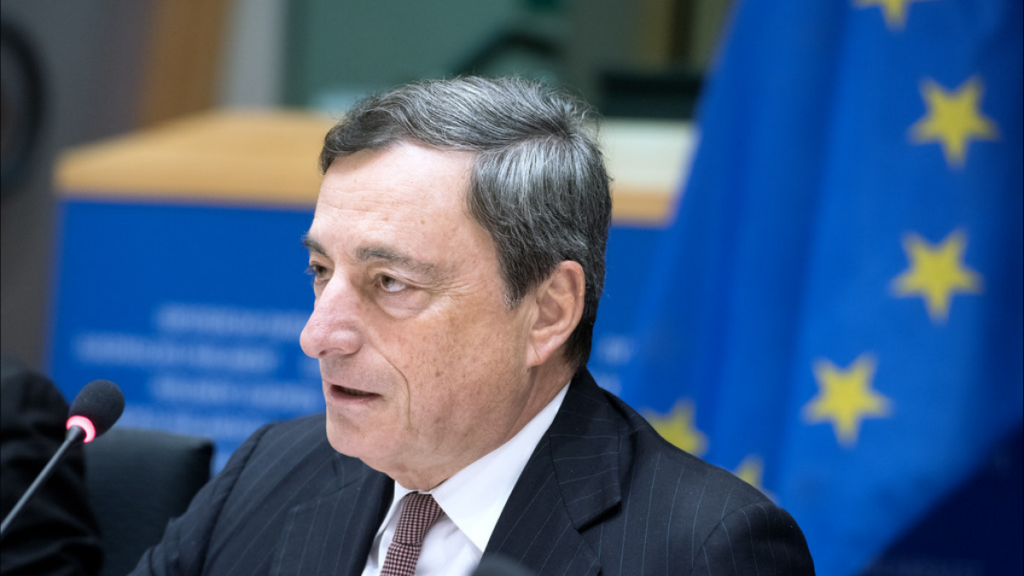
Former Italian Prime Minister and ex-central banker Mario Draghi is once again positioning himself at the centre of Europe’s economic debate, as EU leaders prepare for an informal summit next week amid growing concerns over the bloc’s global standing.
Speaking on Monday, Draghi previewed the message he intends to deliver to European leaders: the European Union must deepen integration and move toward a genuine federal structure if it is to avoid becoming fragmented, economically weakened and strategically sidelined.
The former head of the European Central Bank has long advocated stronger coordination in areas such as defence, trade and monetary policy, as well as joint financing for shared priorities. This time, however, his warning came with a sharper sense of urgency, as he described the current international system as effectively broken and ill-suited to Europe’s slow decision-making model.
According to Draghi, not all EU member states need to advance at the same pace. Those willing to deepen integration, he argued, should be allowed to move ahead, rather than being held back by unanimity. In his view, Europe commands respect on the global stage only in those areas where it has already pooled sovereignty.
Draghi’s remarks come as the EU struggles to keep pace with economic powerhouses such as the United States and China, while simultaneously confronting its most serious security challenge in decades following Russia’s invasion of Ukraine. His reappearance has drawn attention in Brussels, where his rare public interventions are closely followed by senior officials.
The informal summit, set to take place at Belgium’s Alden Biesen castle, is expected to revisit the findings of Draghi’s 2024 report on European competitiveness. António Costa, President of the European Council, has expressed hope that the talks will help translate those recommendations into concrete action.
Former Italian Prime Minister Enrico Letta, author of a separate report on the EU single market, is also due to attend the meeting.
International figures are also paying close attention. Mathias Cormann, Secretary-General of the Organisation for Economic Co-operation and Development, urged European leaders to listen carefully to Draghi, while stressing that the EU remains a major success story in terms of stability and prosperity, even as it faces mounting competitive pressures.
As Europe economic future navigates geopolitical uncertainty and economic transformation, Draghi’s intervention underscores a growing sense in Brussels that incremental change may no longer be enough.