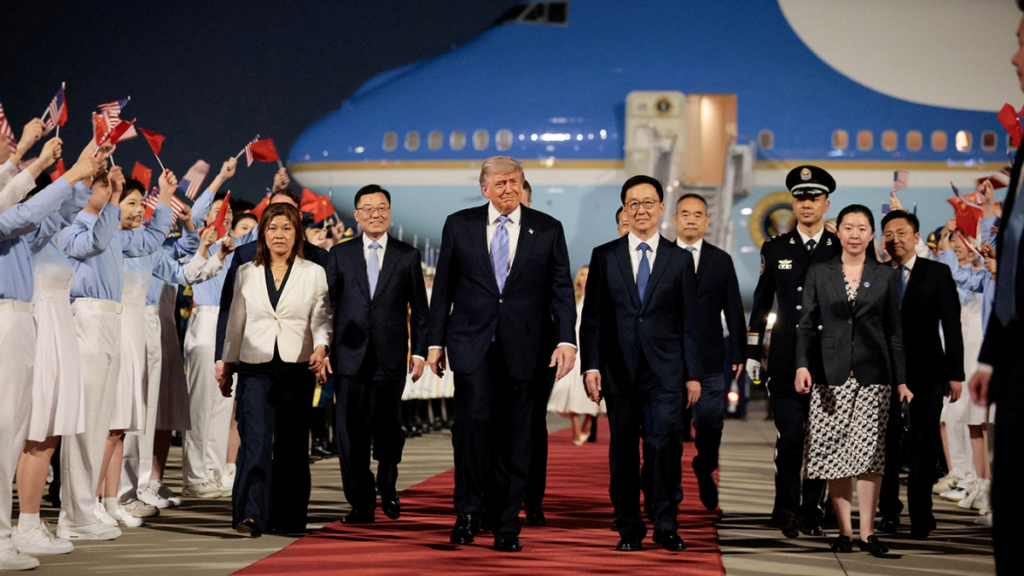
The bilateral summit convened Wednesday in Beijing between United States President Donald Trump and Chinese President Xi Jinping has prompted a significant reassessment of the European Union’s strategic positioning within the global economic order — one that analysts and policymakers in Brussels are increasingly framing in terms of systemic risk rather than mere diplomatic inconvenience.
At the core of European concerns lies a fundamental structural asymmetry: the EU finds itself without a seat at a table where decisions with direct implications for its industrial base, supply chain integrity, and long-term competitiveness may be reached unilaterally by the two dominant global powers.
The Rare Earth Dependency Problem
Perhaps the most immediate and quantifiable vulnerability for Europe resides in the domain of critical raw materials. China retains overwhelming dominance over the global supply chain for rare earth elements — minerals essential to electric vehicle manufacturing, semiconductor production, advanced defence systems, and green energy infrastructure.
Analysts warn that a bilateral US-China arrangement could institutionalise preferential American access to these resources, leaving European industries structurally exposed.
“China appears to be selectively licensing exports while preserving leverage over supply chains considered strategically sensitive, particularly where defence or advanced technology applications are involved,” noted Ilya Epikhin of the consultancy Arthur D. Little.
The consequences are already measurable. German and Japanese industrial sectors have reportedly sustained significant operational disruption as a direct result of Chinese export controls on heavy rare earth elements.
David Merriman, research director at Project Blue, offered a sobering assessment of the medium-term outlook: full supply chain diversification away from Chinese rare earths remains years from realisation, and structural conditions are likely to deteriorate further before stabilisation becomes achievable.
Policy Gaps Within the EU Framework
The EU’s own institutional response has been notably insufficient relative to the scale of the challenge. While the bloc introduced the Critical Raw Materials Act in 2023 — establishing domestic production targets and designating 60 strategic extraction and processing projects — the accompanying policy architecture has failed to address the core economic viability question.
A report published by the EU Institute for Security Studies (EUISS) is unambiguous on this point: Europe has set ambitious targets without adopting the fiscal or regulatory instruments necessary to render those targets financially competitive against China’s state-subsidised industrial model.
This policy gap is not merely technical. It reflects a broader strategic deficit in how the EU has approached industrial sovereignty — reactive in posture, incremental in execution, and chronically underfunded relative to the geopolitical stakes involved.
The scenario generating the greatest concern among EU trade officials is one in which Trump secures a so-called “managed trade” arrangement with Beijing — a bilateral framework that redirects Chinese export surpluses away from the US market and toward Europe as the path of least resistance.
The implications for European manufacturing would be considerable. Chinese electric vehicles are currently produced at a cost between 25% and 50% below their European equivalents. The MG4 compact SUV retails from approximately €30,000, while comparable European models such as the Volkswagen ID.3 are priced from around €40,000.
A sustained increase in Chinese EV penetration of European markets, accelerated by any bilateral US-China trade redirection, could structurally undermine the EU’s automotive industrial base during a period of already acute transition pressure.
Jonas Parello-Plessner, visiting fellow in the Indo-Pacific programme at the German Marshall Fund, underscored the bilateral logic now governing these negotiations: “Realistically, the Trump-Xi talks are becoming very bilateral. And one thing is certain: Trump will only speak for himself.“
Escalation as an Alternative Risk Vector
Analysts are equally attentive to the inverse scenario — one in which the summit fails to produce accommodation, and US-China economic tensions intensify.
A renewed cycle of tariff escalation or sanctions measures between Washington and Beijing would transmit negative externalities to European economies through multiple channels: suppressed global demand, supply chain fragmentation, and heightened financial market volatility.
Chinese officials have signalled a more calibrated and assertive negotiating posture in this second Trump term, reportedly communicating to US business interlocutors that retaliatory measures will follow systematically from any American trade or investment action.
EU Trade Commissioner Maroš Šefčovič has signalled institutional readiness to reinforce the bloc’s industrial policy framework in response to adverse summit outcomes. His public statements have emphasised the EU’s willingness to deploy all available trade defence instruments in protection of European sectoral interests.
Yet the structural reality remains: the Beijing summit is a consequential reminder that the EU — despite its aggregate economic weight — has limited agency over the bilateral dynamics that may determine the parameters of global trade for the foreseeable future.
Neither Washington nor Beijing has demonstrated a disposition to accommodate European interests, and Brussels’ capacity to shape outcomes independently remains constrained by institutional fragmentation and strategic incoherence.
The summit’s conclusions, whatever form they take, are likely to require a serious re-evaluation of the EU’s approach to economic sovereignty — and the pace at which that re-evaluation occurs may itself become a determinant of European industrial resilience.