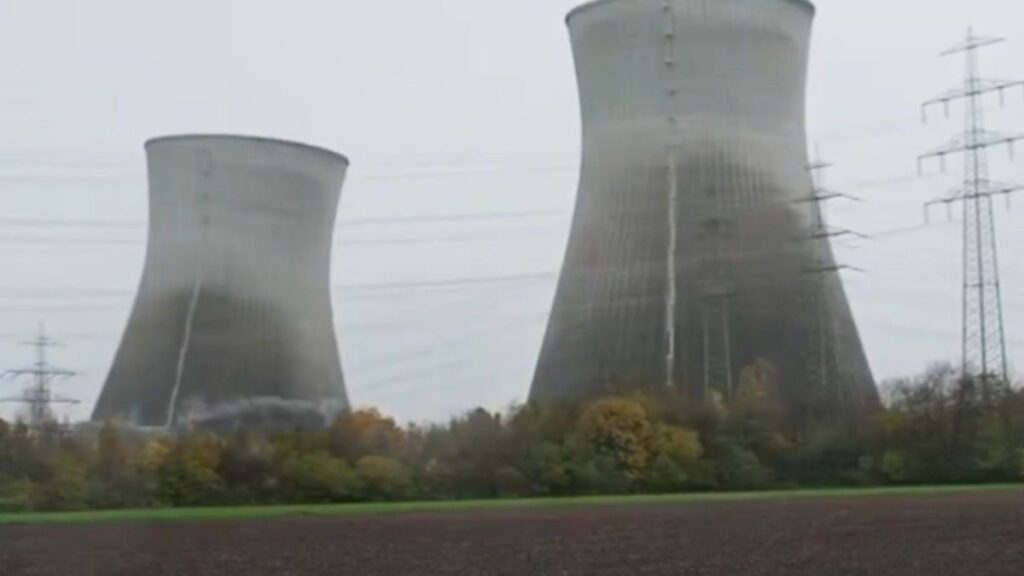
Not every day can one witness, live on television, the “suicide” of a major economic power. But that is exactly what German viewers saw live during the demolition of the last cooling towers of Germany’s final nuclear plant in Gundremmingen (Bavaria), which produced a quarter of the state’s total energy. At 12:01 p.m., nuclear energy became history in the once “European locomotive.”
It was purely a symbolic act. Although it could have been reactivated in four years, the plant had already shut down its reactors in 2017 and 2021.
Germany, until recently the industrial heart of the European Union, now has the most expensive energy in Europe due to an environmentalist creed that is destroying its economic prospects. This milestone last Saturday comes shortly after Hamburg, the capital of German industry, voted on its own industrialization over the next fifteen years. One in five municipal utility companies in Germany expects to dismantle its entire natural gas network by 2045. Germany is committing economic suicide.
It is a political problem that ignores the renewed rise of nuclear energy elsewhere in the world. Today, around 440 nuclear reactors operate globally, with a total capacity of approximately 390 GW, generating about 9% of the world’s electricity. Considering nuclear programs in Asia, this share could reach 12% by 2040, with total capacity growing roughly 87% to reach 746 GW.
All this suicidal madness stems from a green ideology that poisoned German politics long before spreading to the rest of the West, starting in the 1960s. Through tireless media work, building a powerful network of NGOs, and influencing schools and universities—fueled by the shock of the Fukushima nuclear disaster in Japan caused by a tsunami—they managed to integrate both the climate movement and anti-nuclear stance into the programs of all major parties.
None of the political parties that have governed in recent decades are innocent; all embraced eco-socialist ideals of centralized energy policy, the destruction of nuclear power, the fight against combustion engines that advanced technologically each year, and an absurd regulatory obsession under the net-zero climate agenda.