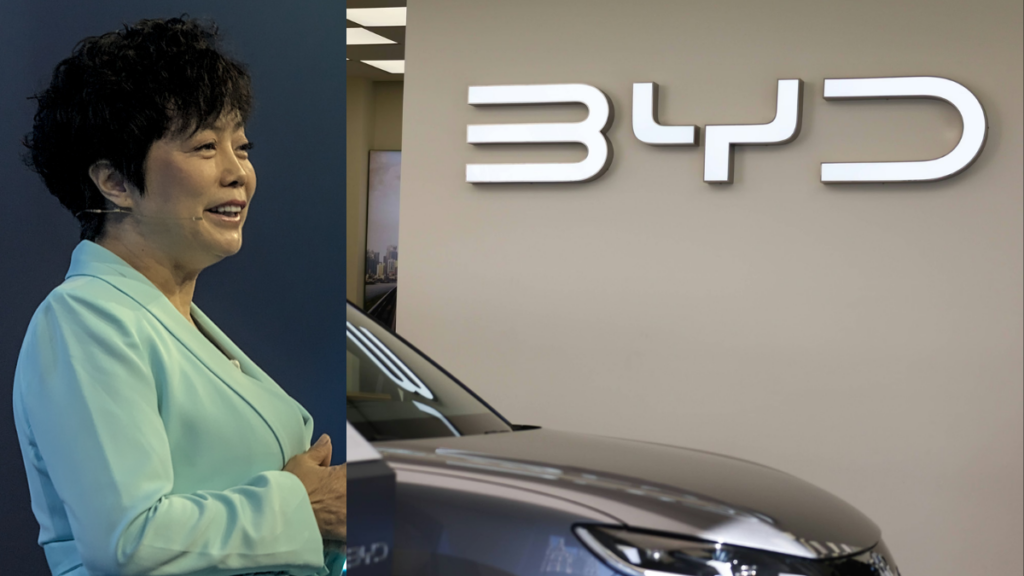
BYD’s global rise from battery supplier to electric vehicle powerhouse has been rapid, and according to its executive vice president Stella Li, the company is now focused on infrastructure, manufacturing scale and localisation as the next phase of the EV race.
Speaking to Euronews Next at the World Government Summit 2026 in Dubai, Li described BYD’s expansion strategy as long-term and deliberately global, with Europe playing a central role.
Once primarily known for producing batteries, BYD has become one of the world’s most influential EV manufacturers, overtaking Tesla in global electric vehicle sales last year. In 2025 alone, BYD delivered more than 2.2 million battery-electric vehicles, underlining its rapid growth.
Li said the company’s move into car manufacturing was always part of its long-term vision. BYD’s background in electronics manufacturing, she argued, gave it a structural advantage when developing electric vehicles from the ground up.
That industrial foundation remains central to BYD’s strategy today. The company employs more than 120,000 engineers in research and development and is deeply embedded in global electronics supply chains, producing components and assemblies used across consumer technology.
In Europe and the Gulf region, BYD now markets more than a dozen vehicle models, ranging from compact city cars to high-performance vehicles. At the upper end, the company has showcased models such as the YANGWANG U9 Xtreme, while mass-market models focus on safety and urban mobility.
Li highlighted the Dolphin model as an example of BYD’s European-focused approach. Designed for city use, it has earned a five-star Euro NCAP safety rating and was named World Car of the Year 2025.
Fast charging and local production
Charging infrastructure remains one of the main barriers to wider EV adoption, particularly in Europe. Li said BYD is addressing this through battery storage, solar integration and ultra-fast charging technology.
The company has developed one-megawatt charging systems capable of delivering up to 400 kilometres of range in five minutes. BYD plans to deploy around 3,000 fast-charging stations across Europe by the end of the year.
On trade tensions, Li downplayed the long-term impact of tariffs on Chinese automakers, arguing that protectionism ultimately hurts consumers. Instead, BYD is prioritising local manufacturing.
A new production facility in southern Hungary, representing an investment of around €4 billion, is expected to begin operations in the second quarter of 2026, anchoring BYD’s European supply chain.
Li also pointed to the Middle East as a key growth market, particularly for battery storage, autonomous driving and robotics. BYD already has a national energy storage partnership with the UAE government, positioning the region as a testing ground for future technologies.
As competition in the EV sector intensifies, Li made clear that BYD’s strategy relies on speed, scale and proximity to its markets, rather than short-term trade disputes.